Chapter 28
Hovey

Organization – Dr. Simon Hovey – The Early Settlers –
Discovery of Oil – Wonderful Production of the Robinson Farm – Thom�s Run –
The Bridge Across the Allegheny – Miscellaneous Information.HOVEY is a new township, formed in 1870, from a part of Perry.
In 1873 its dimensions were much reduced by the formation of Parker City from
the southern part of its territory.The township derives its name from Dr. Simeon Hovey, who was
one of the pioneer settlers, and a very prominent man in the early history of
the county. Dr. Hovey was a native of Connecticut, a man of liberal education
and fine abilities. He served as a surgeon under Gen. Wayne during the Indian
campaigns of the latter, and afterward settled at Greensburg. In 1797 he came
into the then sparsely settled region west of the Allegheny river, and located
on a tract of land within the present limits of this township. Why a man of
his talents should desire to escape from civilization and bury himself in the
wilderness, it is not our province to determine. It may have been that he was
actuated by a love of adventure. He established himself upon his land and
remained about three years. He then returned to Greensburg, where he practiced
medicine about five years, then returned to his former habitation in this
county. His knowledge and skill as a medical adviser became known, and as
physicians were then very few in this section, he was kept constantly busy
ministering to the sick and afflicted in all the surrounding region. His
opinions were highly valued, and he ranked among the best and most skilled
physicians in the county. He was employed night and day visiting patients in
localities far remote from his home, besides often being called to consult
with the physician of Kittanning, Clarion, Butler and neighboring towns. His
life was one of usefulness and good works, and he was widely esteemed. He was
a perfect gentleman in appearance and character. He died about 1837, in the
seventy-eighth year of his age. His nephew, Elisha Robinson, inherited his
property. Dr. Hovey was married, but left no children, and, but for the memory
of the older people of this county who knew him and rightly estimated his
worth, his name might long since have been forgotten.Alexander Gibson was one of the first settlers of the
township. He took up land and made a small improvement, but disposed of it to
Dr. Hovey.Elisha Robinson, a native of Windham, Connecticut, came to
this county in 1812, while a young man, and began improving a part of the
tract belonging to his uncle, Dr. Hovey. Soon after his arrival he started a
tannery, where he carried on the business of tanning and making shoes for over
fifty years. He was a man possessed of true Yankee spirit and enterprise.
commencing life with nothing but his hands and his trade as a means of
support, he gradually acquired land and property until he became the possessor
of 1,100 acres in his home farm, besides holding other interests which it is
not necessary to specify. He was honest, upright and benevolent. He married
Elizabeth Rohrer, of Greensburg, a niece of Dr. Hovey�s wife, and had a
family of six children, who reached mature years: Mary A. (Bovard),
Manorville; Olive (McConnell) deceased; William D., Kittanning; Simeon H.,
Samuel M. and Elisha, Hovey township.Mr. Robinson died in 1874 at a very advanced age. His sons,
Elisha and Samuel, wealthy and prominent farmers, now own the homestead farm.Mr. Robinson�s first purchase of land was the “Thom�s
run” property, a 400-acre tract, which he paid for in shoes and leather.
The Grant farm in Butler county, which became famous as oil territory and
produced from $200,000 to $300,000 worth of petroleum, was sold by Mr.
Robinson to Abel Grant for $100, and was never paid for until its value as oil
property was discovered. The Robinson farm became one of the most noted
properties in the entire oil region. Upon it was made the first discovery of
oil which led to the development of the Parker and Butler county fields. In
1865 a portion of the farm was purchased by a Philadelphia company and a well
was sunk under the superintendence of W.D. Robinson. Oil was struck October
10, 1865. The well proved to have a production of about twenty-five barrels
per day, which was an important yield at the price of oil which then prevailed
– $8.50 per barrel. This well was controlled by the Clarion and Allegheny
River Oil Company, and was known as Clarion No. 1. Three other wells were put
down in the neighborhood prior to 1869, one on the Robinson farm and two on
the Parker farm. Then came the excitement and wells multiplied in every
direction. Mr. Robinson received one-eighth royalty from the production of the
wells as his share, and for a continuous period of six or seven months this
royalty netted him from $30,000 to $40,000 per month. Mr. W. D. Robinson, of
Kittanning, estimates that the oil pumped from this farm from the first
discovery up to the present time must have reached the value of nearly
$2,000,000. There are still several producing wells yielding from 200 to 300
barrels daily.Robert Mena and Hamilton Redick were the first settlers upon
the land which subsequently became the Graham farm. Gen. Thomas Graham, a land
surveyor, came from the eastern part of the state and settled upon this farm
soon after Robinson settled in the township. Graham had been a militia general
in former years. He devoted himself to farming and surveying. He as a man of
contentious disposition and did not get along well with his neighbors. He once
sued Dr. Hovey, charging him with slander. The case attracted much attention.
Distinguished counsel were employed on both sides. The jury brought in a
verdict for the plaintiff, placing the damage at six cents. Gen. Graham�s
death resulted from a horse kicking him upon the head. After this sad event,
his family scattered. The farm is now owned by the Fox heirs and others, and
has proved valuable oil territory. James Fowler, a prominent and respected
citizen of this township, purchased part of the Graham tract which is his
present home in 1850. Mr. Fowler is a native of Parker township, Butler
county, where his father, John Fowler, was one of the pioneer settlers. A
small oil town was built upon his farm, opposite Foxburg. The first discovery
of oil on this farm was made in 1869 by the Ridgeway Oil Company.John Lowrie, a Scotchman, settled in Butler county, near
Emlenton, in 1796. His land extended to the river and included the most
northern portion of Armstrong county. He was the father of Hon. Walter Lowrie,
afterward United States senator, secretary of the senate, and secretary of the
American Board of Foreign Missions of the Presbyterian church. Another of his
sons, Hon. Matthew B. Lowrie, became a prominent citizen of Pittsburgh, and
was the father of the late Judge Lowrie, of the supreme court of this state.A revolutionary soldier named Joseph Thom was a pioneer
settler on the stream which is still known as Thom�s run. He built the first
sawmill in this part of the county and operated it for several years. He sold
his tract to Elisha Robinson and moved away.Hovey is a small township both in territory and in population.
In 1880 the inhabitants numbered 560. There are two schools in the township
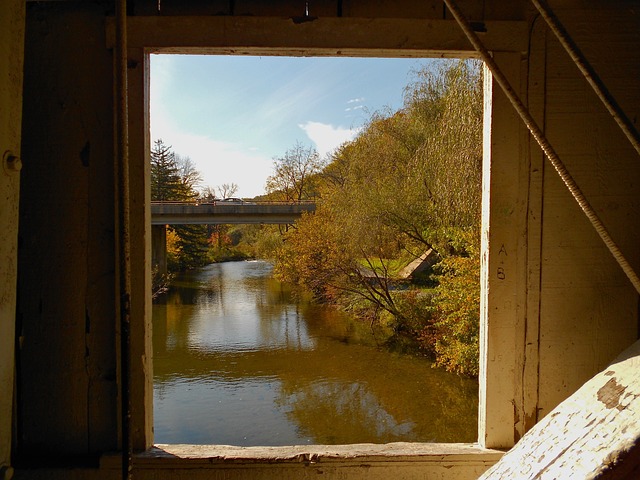
but no churches.In 1873 a strong iron bridge was built over the Allegheny
river between Foxburg and Hovey township. Its cost was $64,000. James Fowler
and the Fox estate were the largest stockholders in the enterprise, each
having invested $20,000. The bridge has recently been sold for $50,000 to the
Pittsburgh & Western and the Pittsburgh, Bradford & Buffalo Railroad
Companies. These owners have removed the iron bridge and are now replacing it
by a wooden structure which is to have a railroad, carriage-road and foot-walk
across it. The railroad from Foxburg to Parker was built in 1881-2.Source: Page(s) 475-576, History of Armstrong County,
Pennsylvania by Robert Walker Smith, Esq. Chicago: Waterman, Watkins &
Co., 1883.
Transcribed March 2000 by Lisa Strobel for the Armstrong County Smith Project.
Contributed by Lisa Strobel for use by the Armstrong County Genealogy Project
(http://www.pa-roots.com/armstrong/)Armstrong County Genealogy Project Notice:
These electronic pages cannot be reproduced in any format, for any
presentation, without prior written permission.
Return to the Historical Index
Return to the Smith Project
About Author
