HEADER
CHAPTER 29
RAYBURN TOWNSHIPNamed after Judge Rayburn–Dewalt Mechling–Other Settlers–Enterprising
Pioneers– Troy Hill–East Mosgrove–Present Industries–Schools–PopulationThis was the last township to be formed in this county, the date being
1890, and the territory was taken from Valley township, after the requisite
number of petitioners had signed the application. It was named after Judge
Calvin Rayburn. First in the chronological order of events we will mention the
few pioneers who made the formation of this township possible by their
settlement and cultivation of its soil in the first quarter of the nineteenth
century.Dewalt Mechling, who came here from Greensburg, Pa., in 1784, was probably
the oldest settler in this township, and his improvement here was the first
made north of the “Purchase Line” in this county. His home was made
over the hill east of the present courthouse, not far from the Cowanshannock
creek. Here he erected a shanty and cleared a patch of ground, but seems to
have become dissatisfied and left in about a year.Robert Patrick, who, with his brother John, was a scout in the Indian wars,
settled on and improved a plot of ground along the river, just above Wickboro,
in 1805. John followed him in 1811, settling at the site of the old Monticello
furnace.In the list below will be found many who settled in the present limits of
this township at various early periods, as well the names of those who held
title to the land but did not improve it:Robert Brown, Alexander McAllister, James Walker, Philip Essex, Joseph
Starr, George Sheckler, Steele Semple, Walter Sloan, David White, John Howard,
Robert Semple, David Loy, John Q. Sloan, Samuel Hutchison, James Buchanan,
Alexander Craig, William Elliott, Jeremiah Bonner, James Galbraith, Peter
Boyers, James Thompson, James Stewart, Daniel Lemmon, Col. John Armstrong, Dr.
James Armstrong, Thomas Duncan, David Lawson, David Reynolds, Paul Morrow,
Samuel S. Harrison, George H. Fox, Valentine Neubert, Isaac Scott, Samuel
Matthews, James Reichert, John Reichert, James Monteith, James Pinks, Robert
Speer, Hugh Rogers, Henry Rousch, Thomas Hamilton, James Hamilton, Jackson
Boggs, Edward S. Golden, Henry Reed, Nathaniel Stewart, John Donaldson, Henry
Reed, Benjamin Glyde, John Fairley, James Sloan, Jr., Simon Truby, John
Brodhead, Rev. Joseph Painter, Darwin Phelps, Daniel A. Daugherty, Frederick
Hague, Marshall B. Oswald, Robert G. Curren, George B. Daugherty, Major Isaac
Craig, Jacob Lowery, William Amberson, William Turnbull, William Peart, Dr.
Abner Bainbridge, Simon Torney, James K. Tittle, John Hood, Robert McClenechan,
Peter Richards, Michael Mechling, James Douglass, Jacob Baumgartner, Peter
Schrecongost, Stephen Collins, Henry Chapman, John Campbell, Thomas
Cadwallader, Thomas Irwin, Sr., Alexander Schrecongost, Jeremiah Parker,
Thomas B. Irwin, Jacob Millison, Sr., Hugh Spence, George Forsyth, Dr. A. W.
Burleigh, Zaccheus Collins, Clement Hill, George Wilt, Patrick McAfee, Louis
Merganthaler.The greater portion of the lands in this township were included in the
bounds of the tract granted by the Penn family to Col John Armstrong in 1775,
and were purchased from the Armstrong heirs by various persons at different
dates.PIONEER ENTERPRISES
First among the millers of this section was Robert Beatty, who put in
operation the first gristmill near the mouth of the Cowanshannock in 1810.
After his death the ownership was successively held by David Loy, 1813; Robert
Brown, 1818; Matthias Bowser, 1826; Isaac Cunningham, 1828; John P. Brown,
1828-37; Robert E. Brown, 1842-63. The last named added a sawmill in 1859, in
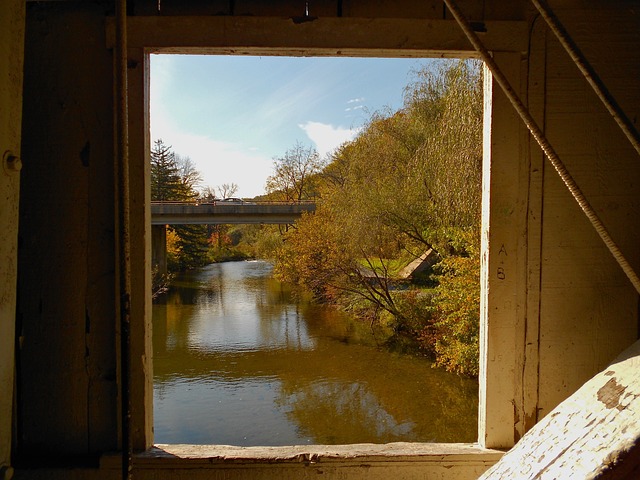
which he sawed the timber for the first covered bridge at Pittsburgh.Another gristmill was erected on the Cowanshannock, some distance above its
mouth, in 1845, by Jermiah Bonner, who was the later constructor of the
Cowanshannock furnace. This mill deserves more than passing mention because of
its fine mechanical construction, which is a credit to the ingenuity of its
maker. Picnic parties from Kittanning frequently make this old mill site their
objective point and the remains of the mill are one of the sights of that
locality. It is probably one of the finest examples of mill construction that
is left from the olden days of the watermill and overshot wheel. The view on
another page will give a clear conception of the methods of construction of
the early millers. At the date of its operation there were two floors of wood
above the stone basement. The gearing is in such good condition that with
little repairs it could do duty at the present time. Some of the millstones
are in fine shape also.The first brickyard in the section now included in this township, as well
as the first in this portion of the county, was that of Robert Stewart, who
started operations on the spot where the present brickyard is located in
Wickboro, in 1813, just one hundred years ago.The second gristmill in the township was that of Alexander McAllister, on
the north side of Pine creek, near the Allegheny, built in 1829. He also
operated a fulling-mill here from then until 1849.Another sawmill was built on the run emptying into the Allegheny below
Mosgrove, by Joseph K. and James A. Lowrey, in 1852. It was later operated by
John J. Sloan and finally by James E. Brown. This mill is still in a good
state of preservation, and can be seen from the windows of trains on the
Pennsylvania railroad. The run at this point was named after John Hays, a
Seneca Indian, who formerly resided there. James Riley kept a hotel here in
1876. Salt works were operated here in 1838 by William Burns.John Patrick ran a sawmill on the Cowanshannock in the southern part of the
township in 1819-26, at which some very wide boards were sawed, taking into
account the rude methods employed then. These mills in 1845 became the
property of Jeremiah Bonner, who at once removed them and on their site built
the Cowanshannock furnace, which was of the type adopted in those early days
of iron making. The furnace was operated until 1853.The Monticello furnace, similar to all the rest of its class, was erected
on the bank of the Allegheny river, near Guthrie’s run. The run gained its
name from Guthrie, a teamster, who, with four mules, slipped into the river
off the steep bank there and was drowned. The furnace was built by Robert E.
Brown in 1859, who sold it in 1863 to McKnight, Martin & Co., for $26,000.
After the change of name to McKnight, Porter & Co., the furnace was
operated until 1875. At that date the settlement at that point consisted of
sixty-eight houses, a store and the postoffice, in charge of William Acheson.
Near this point is the Cowanshannoc station of the Pennsylvania railroad. The
present merchant and postmaster is John Flenner.The first limekiln in the township, as well as in Armstrong county, was
built of stone by Ross Reynolds at the quarry he had opened just above the
northeast corner of the borough of Kittanning in 1866. The employees were
twenty-five, the capacity of the kilns about eight hundred bushels a day and
the market was Pittsburgh. He also operated a small brickyard here at the same
time.TROY HILL
This suburb of Kittanning was founded in 1873 by owners othe old Sloan
tract, and has remained a small settlement with three streets since that time.
It has no industries. Just above the village is the cemetery of the German
Catholics, and a schoolhouse. The cemetery is called St. Josephs.EAST MOSGROVE
was named from the famous landowner and furnaceman, James B. Mosgrove, who
built the Pine Creek furnace. The station is now merely a crossing of the
Pennsylvania and Buffalo, Rochester & Pittsburgh railroads, and is a small
village of twenty or more houses, a hotel and the store and post office, kept
by W. H. Moore. Dr. McGivern resides here and has an extensive practice
through the surrounding country.James A. Lowery opened a store near the mouth of Pine Creek in 1852. The
Brattonville postoffice, of which he was postmaster, was established here in
the autumn of 1852, so named after Miss Jane Bratton Brown, daughter of the
vendee of this purpart. It was removed to the “Barton Bend House,”
on the Hutchinson land, in 1855, and was discontinued in 1857.The Pine Creek station on the Allegheny Valley railroad, which was extended
to this point in the winter of 1866, and the junction of Brown &
Mosgrove’s narrow gauge railroad were located here. The “Peart’s
Eddy” postoffice was removed hither and the second “Brattonville”
one was established Dec. 8, 1870, James Hull being the first postmaster.PRESENT INDUSTRIES
Near the mouth of the Cowanshannock are the works of the Cowanshannock
Brick & Manufacturing Company, with twenty kilns and a capacity of fifty
thousand firebrick per day. They operate their own mines and have their own
gas wells for the burning of the brick.The old Reynolds clay quarries at Wickboro are now leased to the National
Refractories Company, who have a brick works at West Apollo, Westmoreland
county.SCHOOLS
The first schoolhouse in this township was built on his farm by Anthony
Schrecongost in 1853. It was near the Pine Creek Baptist church. Another was
built some years later on Cowanshannock creek, in the lower end of the
township.By referring to the sketch of Valley township an estimate of the number of
schools, scholars, teachers, and cost of operation previous to the division of
these two townships can be made.In 1913 the number of schools was 6; months taught, 7; male teachers, 1;
female teachers, 5; average salaries, male, $50; female, $50; male scholars,
175; female scholars, 151; average attendance, 205; cost per month of each
scholar, $2.81; amount tax levied, $3,236.39; received from State, $1,754.90;
from other sources, $3,184.29; value of schoolhouses, $18,500; teachers’
wages, $2,100; other expenses, $2,755.19.The school directors for that year were: John Flenner, president; James L.
Lucke, secretary; C. A. Adams, treasurer; W. H. Moore, G. W. Steffey.POPULATION
The first census taken of Rayburn township was that of 1900, which gave the
population as 1,882. That of 1910 showed a reduction to 1,384.The assessment returns for 1913 show: number of acres, timber, 1,580,
clear, 5,874, valued at $161,774; houses and lots, 340, value, $56.445,
average, $166.01; horses, 116, value, $4,165, average, $35.90; cows, 164,
value, $2,347, average, $14.31; taxable occupations, 427, amount, $8,865;
total valuation, $296,920. Money at interest, $49,854.98.Attention is directed to the sketch of Valley township for a report on the
geological formation of Rayburn.The loftiest spot in the township is situated betwen Hays’ run and
Cowanshannock creek, near the Allegheny, and is 1,405 feet above the sea.Source: Page(s) 211-230, Armstrong County, Pa., Her People, Past and
Present, J. H. Beers & Co., 19114.
Transcribed July 1998 by James R. Hindman for the Armstrong County Smith
Project.
Contributed by James R. Hindman for use by the Armstrong County Genealogy
Project (http://www.pa-roots.com/armstrong/)Armstrong County Genealogy Project Notice:
These electronic pages cannot be reproduced in any format, for any
presentation, without prior written permission.Return to the Beers Project
Return to the
Armstrong County Genealogy Project
Return to the
Armstrong County Genealogy Project
Return to the
Armstrong County Genealogy Project
(c) Armstrong County
Genealogy Project
About Author
