HEADER
Chapter 22
South Bend TownshipORIGIN OF NAME-SETTLERS AND LANDOWNERS-FIRST
INDUSTRIES-CHURCHES-SCHOOLS-POPULATION-GEOLOGY AND ALTITUDEThe name of this township naturally occurred to the original signers of the
petition for its formation in 1867, because of the sharp southward bend of the
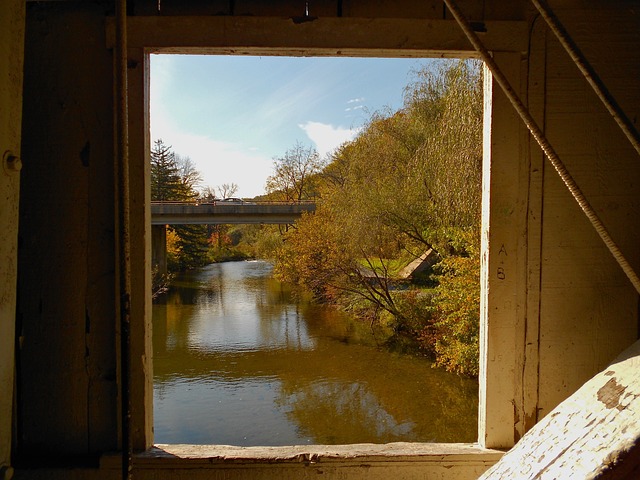
creek which is rightfully named “Crooked.” The separation of the
township was made from those of Kiskimetas and Plum Creek, the boundaries
being stated as: “Beginning at a corner of Burrell township, on land of
Jacob Hart; thence south 29 degrees east 1 mile and 120 perches to A.
Walker’s; thence south 2 miles to the top of a hill on I. Horn’s land; thence
south 34 degrees east 1 mile and 108 perches to the Indiana county line, on or
near to land of Robert Elder; thence by Indiana county line north 37 �
degrees east 6 miles and 172 perches to a point on land of John Ramsey; thence
north 40 degrees west 220 perches on the banks of Crooked creek, near Reuben
Allshouse’s (Idaho) mill; thence down said creek north 80 degrees west 150
perches; thence across said creek north 50 degrees west 3 miles on land of
Isaac Rowley, deceased; thence south 87 degrees west 1 mile and 97 perches, on
land of M. Davis; thence by the line of Burrell township south 15 degrees east
1 mile and 258 perches to Linsbigler’s run; thence down said run south 70
degrees west 110 perches; thence south 56 degrees west 64 perches to Crooked
creek; thence 31 degrees west 1 mile and 308 perches to the place of the
beginning, containing about 23 square miles.Along that portion of Crooked creek in the southwestern part of this
township, near the Indiana county line, some of the earliest settlements made
by whites in this county were made. There were thirty-five original tracts in
this township, the warrants for them being dated as early as 1773.The early landowners and settlers were: James Gray, Abraham Hunt, Samuel
Hancock, James Elder, James Smith, Robert L. Hooper, William Forbes, Stephen
Duncan, Joseph Speer, Ann Kirk, Samuel Fleming, Daniel Drinker, Charles
Hancock, Alexander Todd, Andrew Cunningham, John Bringhurst, Jacob Snow,
Walter Finney, Peter Henry, Samuel Sloan, Samuel Massey, William Heffelfinger,
Christopher Miller, Joseph Saunders, John Finney, Henry Allshouse, Matthew
Irwin, Jacob George, John Wherry, John Walker, John Household, James Davis,
Erasmus Beatty, Nicholas Fulmer, John Rightor, William Eakman, George Woods,
George Rupert, John Levering, Christopher Rupert, Samuel Dixon, James Skullnot,
George Smith, Robert Dick, Elizabeth Pile, Hannah Gregory, John Sloan, David
Todd, William Wasson, Philip Rearigh, Joseph Lowery, Alexander George, Rowland
Chambers, Hugh Neeley, Anthony Montgomery, John L. Howell.
FIRST INDUSTRIES
On the tract originally owned by Howell in 1776, on Crooked creek, near the
present town of South Bend, Charles Campbell, in 1805, erected a frist and saw
mill, it being for many years thereafter the only mill for settlers from miles
around in this and Indiana counties. It was called Frantz’ mill, from Jacob
Frantz, who owned it in 1813. It is now operated by W. E. Fryor.Absalom Woodward was assessed with a grist and saw mill in 1811, which he
had built on the south side of Plum creek, near its junction with Crooked
creek. Reuben Allshouse, who owned these mills in 1876, called the settlement
around them “Idaho,” from the fact of his having made a fortune in
that western State. This settlement is still called by the same title. Tow
miles below here was the store of Hugh Brown in 1805.Besides the saw mills at Idaho and South Bend there were in pioneer days
four others. One was a short distance west of Olivet, another on Craig’s run,
about fifty rods from its mouth, one on a run emptying into Crooked creek
above its mouth, and another on the same run, higher up.In 1874 James McNees started a pottery on Crooked creek near Girty. For a
time he made crocks, but in 1876 he formed the firm of McNees & Co., and
began the manufacture of stone pumps and pipes for wells and cisterns. This
finally was abandoned and the works closed. George W. McNees, his son, is now
manager of the Kittanning Clay Products Company.The Mutual Fire Insurance Company, of South Bend township, was incorporated
in 1875. They have been in business ever since, doing a good business among
the farmers.The assessment list of the year 1805 showed one weaver, Peter Rupert; one
blacksmith, Joseph Thorn; and one stonemason, Barnard Davers.In 1876 there were five stores in the fourteenth and one in the thirteenth
class. There were 27 laborers, 7 blacksmiths, 4 shoemakers, 2 carpenters, 2
millers, 2 wagonmakers, 1 preacher, 1 book agent, 1 clerk, 1 cooper, 1
apprentice, and 26 single men. (And it was leap year.)In 1913 the merchants were T. C. Bair at Olivet, D. B. & L. A. Townsend
at South Bend, Fred W. Meyers at Idaho, and U. S. George at Girty.
EARLY POSTMASTERS
The only post office between Kittanning and Indiana one hundred years ago
was that kept by Absalom Woodward at the point now called Idaho. The office
was discontinued when that at Elderton was opened. The Frantz’ Mills post
office was established in 1843, with James Mitchell as the official in charge.
This latter office was at the point on the creek now known as South Bend.
James Johnson, Jr., was postmaster there in 1848. Harry H. Hanna is the
present one. The Olivet postoffice was established in 1850, with John McGeary
in charge. The postmaster there now is Torrence Bair, also storekeeper. The
postmaster at Girty is J. A. Coulter.Dr. John A. Lowery is the physician at South Bend, Dr. J. T. Shutt at Girty
and Dr. C. M. Ewing at Olivet.CHURCHES OF EARLY DAYS
For many years after the settlement of this region the only church edifice
was the log one built in 1818 by Absalom Woodward and generously donated to
the public at large. In this and in private houses and barns itinerant
missionaries conducted services for many years.The Associate Reformed Church was organized in 1840 and in 1842 erected a
building in the extreme southeastern part of the township on Big Run, calling
it “Olivet.” The present settlement of that name is located here in
1913. The original membership was twenty. The name of the church was changed
to United Presbyterian when the two church bodies united. Some of the early
ministers were: Rev. Alexander McCahan, 1843-46; M. H. Wilson, 1848-57; Samuel
Anderson, 1859-67; John C. Telford, 1868-78. The Methodists have a church at
Girty, built in 1870. Rev. E. H. Rodkey is the pastor.Zion’s Valley Reformed Church is situated one mile east of the western end
of this township on the bank of a run which empties into Crooked creek. It was
built in 1868, the same year that the congregation was organized. William G.
King, Absalom Klingensmith, H. G. Allshouse, and Joseph Heisley were trustees,
and the first pastor was Rev. H. N. Hoffmeier. Rev. A. S. Lenhart now supplies
the pulpit. St. Jacob’s Evangelical Lutheran Church is located half a mile
north of the village of South Bend, and is sometimes known as the
“Hill” or “White” Church. Jacob Frantz in 1817 donated the
ground on which the cemetery and church building stand, for the use of the
Lutheran and Reformed congregations. This harmonious relation has been
continued to the present time, without a single disagreement, even after the
German language was supplanted by the English. The first pastor here was Rev.
Michael Steck, who served the Lutherans from 1817 to 1823. Services were first
held at the old gristmill of Jacob Frantz, but after 1820 the two
congregations worshiped in a log house. In 1823 the Lutherans were served by
Rev. G. A. Reichert and the Reformed by Rev. William Weinel. Rev. Mr. Reichart
was succeeded by Rev. John H. Bernheim in 1837, and after that period the
successive pastors were Revs. Jacob Zimmerman, David McKee, Jacob H. Wright,
J. W. Hutchison, Thomas J. Frederick, C. M. Wachter, J. A. Flickinger, Jacob
M. Hankey, C. L. Wisswaesser, and the present pastor, Rev. C. F. Miller.
Membership 100, Sabbath school, 65.SCHOOLS
For a while after the first settlement of this region, pay or subscription
schools were taught in private houses in different parts of the then settled
part of the township, which was chiefly along and in the vicinity of Crooked
creek. The first schoolhouse, a primitive log one, was erected probably about
1803, near the present site of St. Jacob’s Lutheran and Reformed Church
edifice, in which the first teacher, or at least one of the earliest, was
James Allison.In the earlier settlement of the southern part of the township there was an
ancient schoolhouse about 200 rods southwest of Olivet, on the farm of Joseph
Coulter, and another about a mile and a half a little west of north from
Olivet, on the farm of David Finlay. The first schoolhouse at Olivet was built
in or about 1820, on the site of G. W. Steer’s old blacksmith shop, and was
known as the “Big Run schoolhouse,” which continued to be used until
1834-35.About a mile distant from Olivet, across the Indiana county line, is
Elder’s Ridge Academy, whose beneficent influence in promoting educational
interests in this region has for many years been effective.The first school year in which this was a distinct school district was
1868. Its first annual report was for 1869, when the number of schools was 6;
average number months taught, 4; male teachers, 4; female teachers, 2; average
salaries of male per month, $38.25; average salary of female per month, $35;
male scholars, 288; female, 244; average number attending school, 433; cost of
teaching each per month, 64 cents; amount levied for school purposes, $902.84;
minimum occupation, 211; total amount levied, $1,113.84; received from
collectors, unseated land, etc, $1,200.44; cost of instruction, $892; fuel and
contingencies, $152.72; repairing schoolhouses, etc., $55.66; balance on hand,
$100.06.In 1876 the number of schools was 6; average number months taught, 5; male
teachers, 6; average monthly salaries, $35; number male scholars, 182; number
female scholars, 179; average number attending school, 298; cost per month, 64
cents; amount levied for school and building purposes, $1,179.30; received
from State appropriation, $237.15; received from taxes and other sources,
$1,233.71; paid for teachers’ wages, $1,050; paid for fuel and contingencies,
collectors’ fees, etc., $196.25.The number of schools in 1913 was 8; average months taught, 7; male
teachers, 3; female teachers, 5; average salaries, male, $46.16; female, $45;
male scholars, 64; female scholars, 85; average attendance, 142; cost per
month, $3.12; tax levied, $1,648.75; received from State, $1,307.81; other
sources, $2, 376.03; value of schoolhouses, $8,000; teachers’ wages,
$2,477.50; fuel, fees, etc., $845.34.The school directors were: A. J. Kunkle, president; J. G. Kinnard,
secretary; J. R. Coulter, treasurer; E. T. Smith, J. D. Miller.POPULATION
The population of South Bend township in 1850 was 1,266; in 1860, 1,571; in
1870, 1,633; in 1880, 1,151; in 1890, 1,116; in 1900, 875; in 1910, 798.The assessment rolls for 1913 show: Timber land, 970 acres; cleared land,
12,338 acres; value of land, $244,069; houses and lots, 35; value $9,992;
average, $285.48; horses, 277; value, $13,948; average, $50.39; cows, 254;
value $4, 115; average, $16.20; taxable occupations, 284; valuation, $4,250.
Total valuation, $297,044. Money at interest, $29,284.17.GEOLOGY AND ALTITUDE
The geological formation of this township is fully treated in the sketch of
Plum creek township. There is a sharp brreak in the Roaring run anticlinal in
the northeastern portion of this township, near Girty.Close to the western line between this and Kiskiminetas township is the
highest hill, 1,443 feet above the sea.Source: Page(s) 190-193, Armstrong County, Pa., Her People, Past and
Present, J. H. Beers & Co., 19114.
Transcribed September 1998 by Donna E. Mohney for the Armstrong County Smith
Project.
Contributed by Donna E. Mohney for use by the Armstrong County Genealogy
Project (http://www.pa-roots.com/armstrong/)Armstrong County Genealogy Project Notice:
These electronic pages cannot be reproduced in any format, for any
presentation, without prior written permission.Return to the Beers Project
Return to the
Armstrong County Genealogy Project
Return to the
Armstrong County Genealogy Project
Return to the
Armstrong County Genealogy Project
(c) Armstrong County
Genealogy Project
About Author
